
date
16 May > 21 July 2013
location
Wall Of Sound Gallery, Alba (Cn)
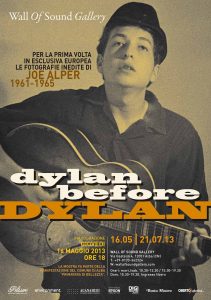 Celebrating the 50th anniversary of Blowin’ in the Wind Wall Of Sound Gallery is proud to present, for the first time ever and as a European exclusive, the Dylan Before Dylan exhibition with the historic photographs by Joe Alper. Like last year with the Art Kane show, the editing, the restoration of the original negatives as well as the printing have been made at our gallery, in Alba, with the loving supervision of Edward Elbers, manager of the Joe Alper Photo Collection LLC.
May 1961. Bob Dylan barely turned 20 has arrived in New York four months earlier. After roaming all around America, from his native Minnesota through Iowa, South Dakota, Kansas, North Dakota, New Mexico, and taking on an unspecified number of identities (“You can go anywhere when you’re somebody else”), he starts building a reputation in the folk clubs of the Greenwich Village, like Gerde’s Folk City. Since the Twenties the Village has become the mecca for any bohemian, poet, artist and misfit looking for freedom from conventions and bad traditions. At the time the Village is also one of a few interracial melting pots. Being a huge fan of Woody Guthrie, the great folk legend who’s dying at the Brooklyn State Hospital, Dylan sports a business card that says “I ain’t dead yet”, signed WG. But, as his friends way back in Minneapolis would say, he’s standing at the same mystic crossroads where they say thirty years earlier Robert Johnson has sold his soul to the Devil in order to become a music genius. How could you explain otherwise Dylan’s stunning metamorphosis when, during the same Spring, he’ll return home for a brief visit, with a surprisingly new voice and a sudden mastery with the guitar? Truth is, that time had erased every trace of his past and the future is just pure imagination. “I didn’t have a past to talk about, nothing to go back to, nobody to count on”, Dylan says to director Martin Scorsese in his No Direction Home film. “Only folk music could communicate to me something that was in synch with my feelings towards life, people, institutions, ideologies. At that time everything that counted for me was learning as many folk songs as possible, but the majority of the people I knew thought it was stuff from the past, really archaic. I don’t know why, but to me it seemed that those songs were nailing the present better than anything else”.
In the same month of May 1961, in Branford, Connecticut, where Dylan is due to perform at the Montowese Hotel, there’s also a photographer waiting for him. His name is Joe Alper. 37 years old, a jazz and folk fan, Alper is already shooting a variety of important record covers for artists like John Coltrane, Charlie Mingus and Pete Seeger, but never fails to shoot and support, with a fervor shared with his wife Jackie, the young upcoming folkies that get to perform in the local clubs and cafes, like the historic Caffe Lena in Sarasota Springs. The Alper’s are in the right milieu. Jackie works as secretary to the legendary ethnomusicologist Alan Lomax and, like Joe, is a close friend of Pete Seeger, another hero of folk music and civil conscience. Joe has only recently devoted himself to photography, certainly to follow his passion for music, but also hoping to find a way out from his dramatic financial situation. Unfortunately a more serious problem is looming large: his battle, just begun, with ADPKD is bound to end tragically with his death in just a few years, in 1968.
Alper often follows Dylan with his camera, at the Indian Neck Folk Festival in 1961 or more north, in January 1962, at Caffe Lena or at the San Remo in Schenectady. On these occasions Dylan will gladly stay at the Alper’s house in Brandywine Avenue. Therefore the historic value of Joe’s photos of Dylan at this early stage in his career is invaluable, not only because they record fundamental passages, from his first steps until the electric revolution at Newport 1965, but most of all because they show an artist in progress, informally, without the masks he’s already wearing in the same period when posing for other photographers like Barry Feinstein, David Gahr, Ted Russell or John Cohen. Captured in an unusual domestic bliss, often with his fiancée Suze Rotolo (the same immortalized by Don Hunstein on the cover of the Freewheelin’ Bob Dylan album), or playing with constructions with Alper’s kids, or singing for Pete Seeger and an asleep Rev. Gary Davis at Gil Turner’s wedding (another key figure in the Village’s folk scene), Joe Alper really records a “Dylan before Dylan” with simplicity and immediacy. The same can be said of when, in April 1962, Alper gives a ride with his car to Dylan going to Columbia Studios for his first recording session with legendary producer John Hammond for what will become The Freewheelin’ Bob Dylan album, the one that features Blowin’ in the Wind.
Although never exhibited before, some of these images have been seen by the general public as they’ve been featured on Dylan’s The Witmark Demos: 1962-1964 album as well as in Scorsese’s No Direction Home film and related soundtrack album booklet. This exhibition, which showcases over 50 photographs printed in various sizes from 11×14 to 30×40, is made even more precious with a selection of images, also historic and rarely seen, of some jazz, blues and folk greats like Aretha Franklin, Nina Simone, Muddy Waters, Thelonious Monk, Joan Baez with her sister Mimi and her husband Richard Farina, Pete Seeger, John Coltrane in the recording studio with producer Bob Thiele, Miles Davis, Duke Ellington and Ella Fitzgerald, Dizzy Gillespie with Quincy Jones, Ray Charles in a rare image of him soloing on tenor sax, Charlie Mingus with Max Roach, Howlin’ Wolf, Joe Zawinul, Mississippi John Hurt and Elizabeth Cotten, Big Joe Williams. Alper’s camera makes the intensity of these artists’ performances and their magnetism palpable, capturing them in a dimension that – be it the stage of the first big folk and jazz festivals of the time, or the aseptic intimacy of a recording studio – seems even more miraculously friendly and livable. This is a unique record of an unrepeatable era when, as Dylan puts it, “the performers I saw and I wanted to be shared the same thing: it was in their eyes and it seemed to want to say: ‘We know something that you don’t know’. That’s the kind of performer I wanted to be”.
Guido Harari, Wall Of Sound Gallery