
date
25 May > 09 September 2012
location
Wall Of Sound Gallery, Alba (CN)
 “I think of Art Kane as being strong, say, like a pumpkin sun in a blue sky. Like the sun, Art beams his eye straight at his subject, and what he sees, he pictures – and it’s usually a dramatic interpretation of personality.” – Andy Warhol
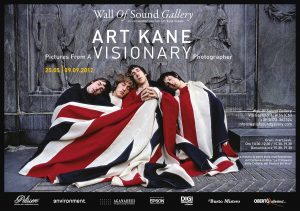
Art Kane is the legendary photographer that at 10am on one August day of 1958 immortalized some 57 jazz greats on a sidewalk on 126th Street, in Harlem, unaware he was creating the single most significant image in the history of jazz. This photograph is universally famous as “Harlem 1958” and it won him the Art Directors Club of New York gold medal. Since then his eyes have captured the greatest artists in rock, pop, soul and once more jazz, from The Rolling Stones to Bob Dylan, The Doors, Janis Joplin, Jefferson Airplane, Frank Zappa, Cream, Sonny & Chér, Aretha Franklin, Louis Armstrong, Lester Young, turning them into countless icons, like, one out of many, the memorable shot of The Who wrapped up in a Union Jack.
So much for music buffs. But Art Kane is much more than this. He’s been one of the true masters of Twentieth Century photography, whose visionary images have influenced the social conscience of many generations, leaving a mark on world’s culture. Kane’s photographs are today in the permanent collections of the Museum of Modern Art and of the Metropolitan Museum of Art. However very few know that their author viewed himself as “the poor bastard for whom the real world, quite simply, doesn’t look like it should. My entire philosophy of life is there, up on my studio walls filled with my images. It’s there with its horrible dress on, fat legs wide apart and big hands over giant hips”.
Kane wasn’t interested in the appearance of things, but in how these could make him feel. Kane was an illusionist, a master of photographic Impressionism who to this day elicits emotions and distils ideas. Venice still threatens to disappear, rockstars always announce some Brave New World, solitude in the internet age is even more cosmic, and Kane, ever so amazingly current, already projected all of this in a fantasy world that seems to amplify today’s reality. All of Kane’s images are permeated with his irrepressible passion for life, for his fellow man, for popular culture. These are thinking images that always communicate his highly personal point of view on racism and war, on mysticism or sex, on fashion or music. No concern for “style”, his is an intuitive approach to photography, disarming in its simplicity. And then an impressive variety of ideas, unlikely angles, unique locations, saturated colours. Nothing appears like we would expect: images suggest, provoke, confuse, but it’s the viewer who must complete the picture.
Art Kane (1925-1995) grew up in East Bronx, New York, among refugees from Czarist Russia (the Kanofsky family moved there from Ukraine in 1932). He fought World War II in an extravagant contingent dealing with inflatable tanks to mislead Germans and then became the youngest art director ever with the great Alexey Brodovitch as his mentor. It was Brodovitch, around the end of the Fifties, who pushed Kane on the personal creative odyssey that would turn him into one of the absolute masters of photography.
Within a few months Kane revolutionized this art form, discovering new techniques and customizing others in order to free photography from its “realism”. Kane’s photography is pure energy, powerful imagination. “Reality never lives up to the visual expectations it generates”, he once said. “Rather than simply documenting it with my photographs, I’m interested in sharing the way I feel about things”.
Kane took the Sixties, Seventies and Eighties by storm, creating new standards for commercial photography, fashion and celebrities portraits, nude, with a wild use of 35mm cameras, wide angle lenses and hyper-saturated colour films. He’d make no concessions:“Performance shots are a waste of time, they look like everyone else’s. If you want to shoot a performer, then grab them, own them, you have to own people, then twist them into what you want to say about them”.
In the Fifties Kane understood very well the revolution of colour photography, knowing well, as a former art director, how to compose his visions and most of all how to edit them. His ferociously surgical editing has left very rare outtakes in his immense archives: “I immediately understood that photography can also be an act of rejection, where it’s up to you to decide what is to be left out of the picture”.
Kane honed his skills working with such historic long-gone magazines as “Look”, “Life”,“Esquire” and “McCall’s”. At the time they would pay him fabulous amounts of money in order to publish his photographs as long as they would “eliminate small and ugly to emphasize big and heroic”. This would push Kane on his visionary missions even when fashion, and particularly Diana Vreeland, the powerful “Vogue” editor, came knocking at his door. Depth of field, heavy distorsion produced by the 21mm wide angle which was invented right at that time, selective focus achieved with 180mm and 500mm telephoto lenses, Kane’s visual vocabulary would also incorporate images that were often conceived to be looked at upside down or even ingenious montages of two transparencies in the same mount (the so called “sandwiches”). These inventions were to be widely abused by other photographers, but in the Sixties and Seventies Kane was THE innovator: These sandwiches are only one of many ways to communicate, like a wide angle lens or an under-exposed image. They are poetry to me in order to escape photo realism. Like in life, things happen, but they’re not necessarily dramatic until you step back and capture their essence based on your memory. Memory is extraordinary.